Next.js 16.3: Faster Navigation, Smarter Development & More
Explore the new Next.js 16.3 features including Instant Navigations, Partial Prefetching, AI developer tools, Turbopack improvements, and better performance.
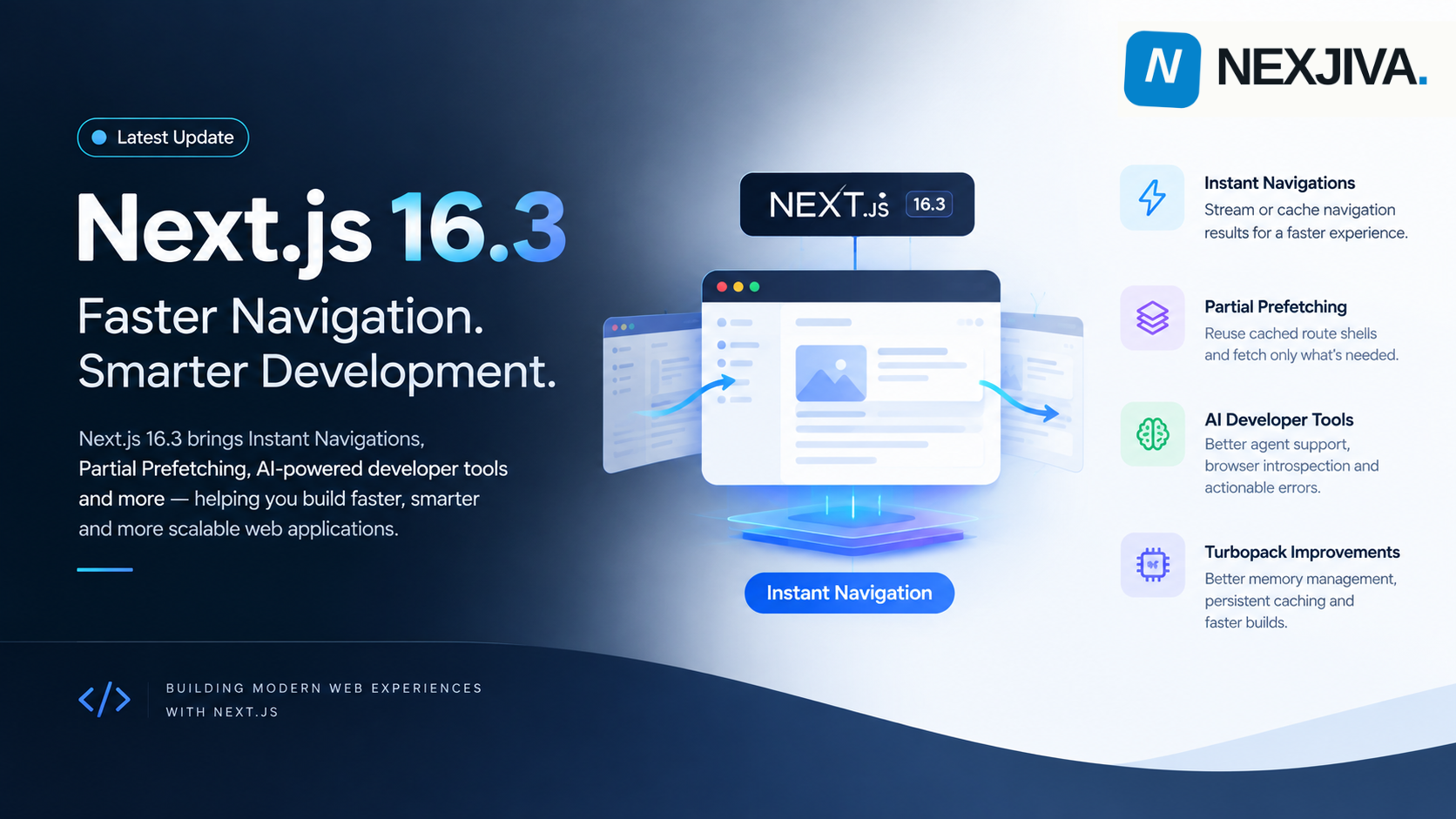
Next.js 16.3 is here, bringing a strong focus on faster navigation, better performance, AI-assisted development, and improved tooling.
For developers building modern SaaS products, dashboards, enterprise applications, and high-performance websites, this release has some useful updates.
What's New in Next.js 16.3?
The major updates include:
Instant Navigations
Partial Prefetching
AI developer improvements
Turbopack improvements
Lower memory usage during development
Faster builds and rendering
Let's look at them in short.
1. Instant Navigations
One of the biggest updates in Next.js 16.3 is **Instant Navigations**.
Next.js can now use streaming or caching to make navigation feel much faster.
This helps applications deliver a more app-like experience while still using the Next.js architecture.
For SaaS dashboards and business applications, faster navigation can make the entire product feel more responsive.
2. Partial Prefetching
Next.js 16.3 introduces improved **Partial Prefetching**.
Instead of downloading everything for a page, Next.js can reuse a cached route shell and fetch only the required content.
This can help reduce unnecessary data transfer and improve navigation speed.
3. Better AI Development
AI-assisted development is becoming an important part of modern software development.
Next.js 16.3 adds several improvements for AI coding agents, including:
AGENTS.md support
First-party agent skills
Agent Browser with React introspection
Better actionable errors
Smaller MCP server
Documentation available as Markdown
These improvements make it easier for AI coding tools to understand, inspect, and work with Next.js applications.
4. Turbopack Improvements
Turbopack also receives important updates.
Next.js 16.3 includes:
Memory eviction
Persistent build caching
Rust-based React Compiler improvements
`import.meta.glob` support
These changes are focused on improving development speed and build performance.
5. Lower Memory Usage
Next.js 16.3 also improves memory usage during development.
The release highlights up to **90% less memory usage in development** in the relevant scenarios.
This can be especially useful when working on large applications or projects with long development sessions.
6. Faster Builds and Rendering
Performance continues to be a major focus.
Next.js 16.3 brings improvements to:
Development builds
Production builds
Rendering
Development memory usage
Navigation performance
For larger Next.js projects, these improvements can make development smoother.
Why Next.js 16.3 Matters
The latest release shows that Next.js is moving beyond basic React application development.
It is becoming a stronger platform for building:
SaaS applications
Enterprise portals
E-commerce platforms
Customer dashboards
AI-powered applications
High-performance websites
The focus is clear:
Faster navigation. Better tooling. Smarter development.
Should You Upgrade to Next.js 16.3?
If you're starting a new Next.js project, using the latest stable release is a good option.
For an existing application, review your dependencies and upgrade carefully.
Before upgrading a production application, always test:
Routing
Caching
Authentication
API integrations
Server components
Build process
Final Thoughts
Next.js 16.3 is not just another framework update.
Its focus on **Instant Navigations, Partial Prefetching, AI development, Turbopack, and performance** makes it an interesting release for modern web applications.
For teams building scalable SaaS and enterprise applications, these improvements can help create faster and more responsive products.
At Nexjiva Digital Solutions, we work with modern technologies such as **Next.js, React, .NET, APIs, and cloud platforms** to build scalable digital products.
Building a modern web application?
Let's build it for the next stage of your business.
Need help building your
SaaS product?
We engineer scalable systems for the future.